
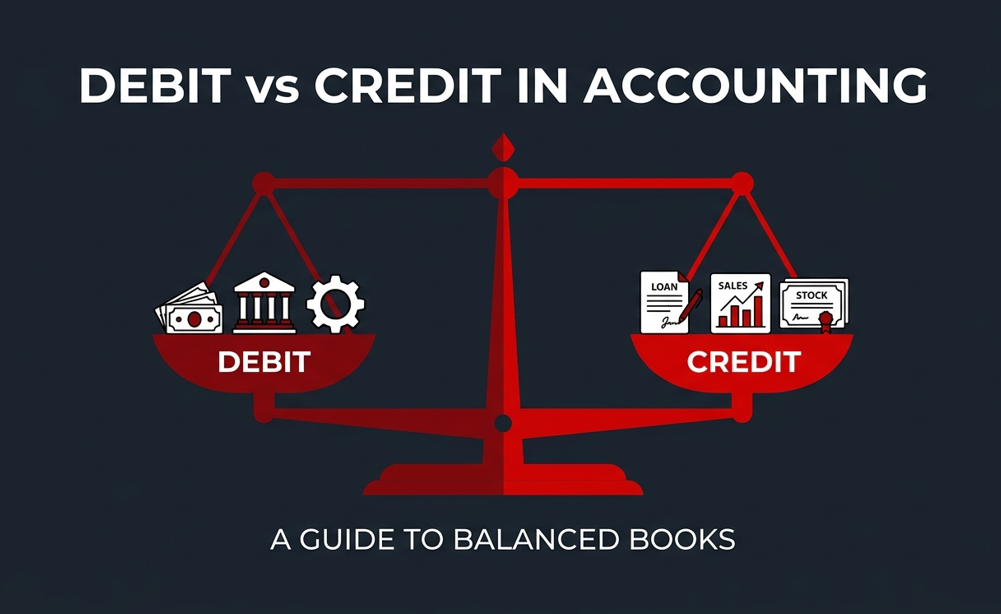
Selecting the right accounting approach is essential for any organization that wants transparent records and clean compliance. In day-to-day bookkeeping, understanding debit vs credit in accounting guides how transactions are posted, how the general ledger stays balanced, and how financial statements reflect real activity.
This article explains the difference between debit vs credit in accounting, shows how each affects common accounts, and outlines practical steps that help businesses maintain accuracy and cash-flow visibility.
Why Debits and Credits Are Vital for Businesses
Debits and credits sit at the core of double-entry accounting. Every transaction touches at least two ledger accounts; one debit, one credit, so totals stay equal and the books remain reliable. In regulated markets, accurate posting supports audits, VAT or tax filings, and management reporting.
As operations grow, consistent use of debit vs credit in accounting reduces errors, speeds month-end close, improves reconciliations, and protects financial integrity. Whether a company uses spreadsheets, accounting software, or a full ERP, the same rules apply.
Debits in Accounting: Advantages and Limits
What a debit does
A debit increases assets and expenses and decreases liabilities, equity, or revenue.
Examples: Receivables, inventory, equipment, prepaid expenses, and utility expenses increase with debits.
Why debits matter
- Clarify resource growth: asset purchases, cost recognition, and capital projects.
- Support cash flow analysis when applied to the cash account (debits indicate cash in).
Limits and cautions
- A debit is not always “good.” Its meaning depends on the account type.
- Over-debiting expense accounts without clear support can distort margins and KPIs.
Credits in Accounting: Advantages and Limits
What a credit does
A credit increases liabilities, equity, and revenue and decreases assets or expenses.
Examples: Payables, accrued expenses, loans, sales revenue, and owner’s equity increase with credits.
Why credits matter
- Recognize income and obligations accurately.
- Track financing sources and retained earnings movement.
Limits and cautions
- A credit is not always “bad.” In revenue, credits show growth; in cash, credits show outflows.
- Misclassifying credits (for example, posting income to equity) can create reconciliation issues.
Key Differences: Debit vs Credit in Accounting
| Account Type | Increases With | Decreases With |
| Assets | Debit | Credit |
| Liabilities | Credit | Debit |
| Equity | Credit | Debit |
| Revenue (Income) | Credit | Debit |
| Expenses | Debit | Credit |
Accounting equation: Assets = Liabilities + Equity
The equation must be held after each journal entry, which is why the difference between debit and credit in accounting is central to reliable records.
Practical Examples:
1) Taking a loan
Debit: Cash (asset)
Credit: Loan Payable (liability)
2) Buying inventory with cash
Debit: Inventory (asset)
Credit: Cash (asset)
3) Recording revenue on credit
Debit: Accounts Receivable (asset)
Credit: Sales Revenue (revenue)
4) Paying a supplier
Debit: Accounts Payable (liability)
Credit: Cash (asset)
Cash note: For the cash account only, debits mean cash in, credits mean cash out. Bank statements may look reversed because customer balances are the bank’s liability.
The Value of a Strong Chart of Accounts
A well-designed chart of accounts (COA) defines each account and its normal balance (debit or credit). Clear categories, concise names, and consistent numbering help staff apply debit vs credit in accounting correctly and speed up reviews, audits, and VAT checks.
Good practice
- Define purpose and normal balance for each account.
- Use standard segments (assets, liabilities, equity, revenue, expenses).
- Avoid duplicate or overlapping accounts.
Key Considerations When Posting Journal Entries
- Document support: invoices, receipts, contracts, and approved memos.
- Account type check: confirm whether the target account normally carries a debit or credit.
- Compound entries: allow multiple lines as long as total debits equal total credits.
- Cut-off: match entries to the correct period for accurate financial statements.
- Controls: approvals, segregation of duties, and audit trails.
Double-Entry Accounting, Subledgers, and Reconciliations
- Double-entry accounting requires at least one debit and one credit for each transaction.
- Subledgers (AR, AP, fixed assets, inventory) roll up to general ledger control accounts.
- Reconciliations align subledgers to the GL and match bank statements to the cash account to confirm that debits and credits were posted correctly.
Software, Automation, and Cash Flow Visibility
Modern accounting software and ERP systems enforce double-entry rules and map postings to the right accounts. Automation helps:
- Reduce manual errors and repeated data entry.
- Create real-time reports on cash flow, revenue, and expenses.
- Standardize recurring journal entries (depreciation, accruals, deferrals).
Automation improves consistency, but teams still need a clear grasp of debit vs credit in accounting to set rules and review outputs.
Conclusion
Debits and credits are the language of reliable books. By understanding debit vs credit in accounting, applying double-entry accounting, maintaining a disciplined chart of accounts, and using appropriate accounting software, businesses keep records balanced, cash flows visible, and compliance on track. The principle stays simple: post every transaction with equal debits and credits, and the accounting equation remains true.
We helps businesses maintain accurate financial records, handle debits and credits efficiently, and stay fully compliant with UAE accounting and tax regulations.
Contact us to optimise your financial operations, ensure compliance, and strengthen overall business performance.