
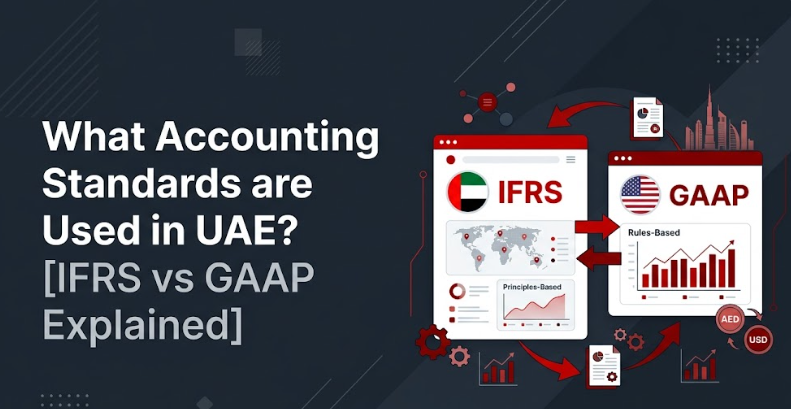
The UAE’s financial reporting environment is built around International Financial Reporting Standards (IFRS), ensuring consistency and transparency across all sectors. Understanding how IFRS differs from GAAP and how it integrates with local statutory rules is essential for accurate accounting and tax compliance.
This article explains What Accounting Standards are used in UAE, their regulatory basis, and how businesses can align with them effectively.
What Accounting Standards Are Used in UAE?
The UAE officially follows International Financial Reporting Standards (IFRS), developed by the International Accounting Standards Board (IASB). IFRS is a globally recognized framework adopted by over 140 countries.
In the UAE:
- All listed companies and most private businesses must comply with IFRS.
- Some smaller businesses may use simplified frameworks based on IFRS for SMEs.
- Local statutory requirements also apply for record-keeping and VAT compliance.
Why Does the UAE Use IFRS Instead of GAAP?
The UAE adopted IFRS for several strategic reasons:
- Global Investor Confidence: IFRS is widely accepted internationally, making UAE businesses attractive to foreign investors.
- Economic Diversification: Aligning with global standards supports the UAE’s vision of becoming a financial hub.
- Consistency and Transparency: IFRS ensures uniform reporting, which strengthens corporate governance and audits.
IFRS vs GAAP: Key Differences
While IFRS is used in the UAE, GAAP (Generally Accepted Accounting Principles) is primarily applied in the United States. Here’s a quick comparison:
| Aspect | IFRS (Used in UAE) | GAAP (Used in USA) |
| Governing Body | IASB | FASB |
| Global Adoption | 140+ countries | Mostly USA |
| Inventory Valuation | Allows FIFO & weighted avg | Allows FIFO, LIFO |
| Development Costs | Can be capitalized | Usually expensed |
| Asset Revaluation | Permitted | Not permitted |
| Approach | Principles-based | Rules-based |
This comparison helps businesses understand why IFRS is the preferred standard in the UAE.
Statutory Accounting Requirements in the UAE
In addition to IFRS, companies must comply with local regulations, including:
- Maintain accounting records for at least 5 years.
- Prepare audited financial statements (mandatory for large corporations and free zones).
- Ensure VAT compliant record keeping.
- Submit reports aligned with IFRS and UAE accounting principles.
Connection to Corporate Tax and Audit Compliance
Since the introduction of corporate tax and stricter audit requirements in the UAE, accurate IFRS-based reporting has become even more critical. Non-compliance can lead to penalties, tax inaccuracies, and reputational risks. Businesses that follow IFRS and statutory rules are better positioned for smooth audits and tax filings.
Challenges in Implementing IFRS
IFRS compliance in UAE can be complex due to frequent updates and formatting requirements. Common challenges include:
- Interpreting IFRS standards correctly.
- Converting historical records to IFRS format.
- Keep up with IASB updates.
- Aligning internal reporting with IFRS-compliant statements.
Compliance Strategies for UAE Businesses
The following steps help businesses meet the requirements of what accounting standards apply in the UAE and avoid penalties:
- Ensure Accurate Licensing: Trade licenses must reflect actual business activities.
- Use IFRS Compliant Systems: Implement accounting software aligned with IFRS.
- Maintain Proper Documentation: Keep records updated and audit ready.
- Hire Skilled Professionals: Employ IFRS-trained staff or outsource to experts.
- Follow Industry-Specific Rules: Certain sectors (e.g., real estate, finance) have additional disclosure requirements.
Which Businesses Must Follow IFRS?
- Free Zone Companies: Must provide audited IFRS-compliant statements to maintain tax benefits.
- Mainland Enterprises: Required to submit full IFRS reports for corporate tax and VAT compliance.
- Startups & SMEs: Use simplified IFRS frameworks but still need accurate records.
Working with Professional Accounting Support
Many businesses partner with experienced accounting firms in Dubai to ensure IFRS compliance and manage statutory obligations. These experts assist with:
- Transitioning to IFRS.
- Ongoing compliance with UAE laws.
- Audit preparation and tax reporting.
- VAT and corporate tax integration.
Conclusion
Understanding what accounting standards are used in UAE is essential for compliance, transparency, and growth. IFRS is the primary standard, supported by local statutory requirements. Businesses that align with these standards not only avoid penalties but also gain investor confidence and operational efficiency.
How We Helps
SimplySolved offers tailored accounting solutions for businesses across the UAE. Our services include bookkeeping, statutory reporting, VAT and corporate tax compliance, and IFRS implementation support, designed to simplify accounting processes and strengthen financial management.
Get in touch today to ensure your business remains compliant and audit ready.