
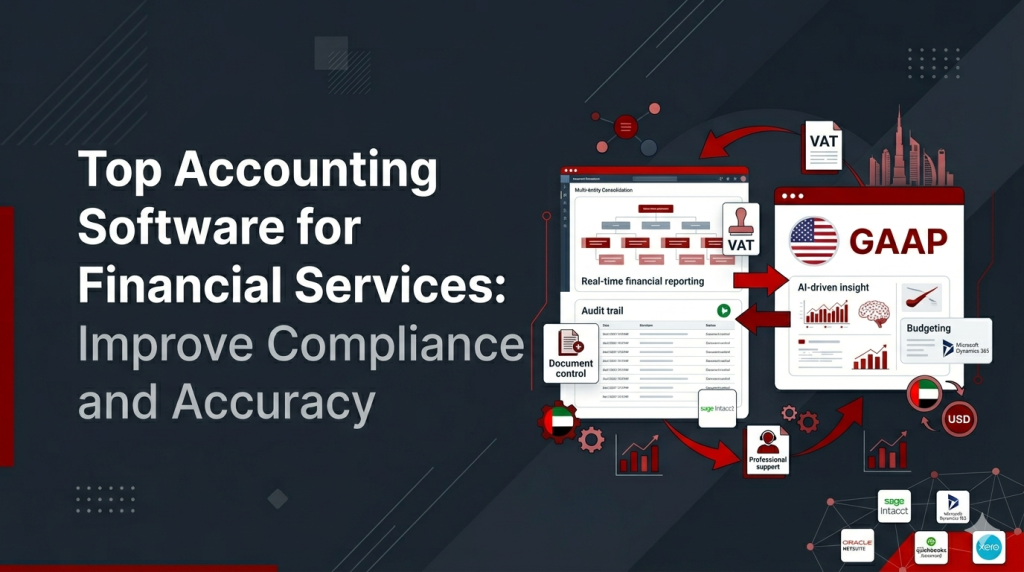
In a fast-moving finance industry, compliance, accuracy, and real-time reporting are essential. This is where accounting software for financial services delivers clear value. Banks, investment firms, insurers, and fintech companies need financial accounting software that goes beyond basic bookkeeping to support regulation-heavy operations.
This article reviews leading accounting software for financial services, explains how these platforms strengthen accuracy and compliance, and outlines what to consider when selecting a system.
Why Specialized Financial Accounting Software Matters
Generic tools struggle with the volume, complexity, and controls required in the finance sector. Accounting software for financial services supports high transaction volumes, multi-entity structures, and multi-currency operations while maintaining an auditable record. Critically, it enables consistent financial reporting aligned to IFRS or GAAP and supports VAT compliance in markets such as the UAE.
Key Features That Improve Compliance and Accuracy
1) Real-time financial reporting
Accurate, timely information is central to financial reporting and risk management. Leading platforms provide configurable dashboards, alerts, and drill-downs so teams can monitor performance and react quickly.
2) Audit trails and controls
Built-in audit trails, version control, approvals, and document management simplify internal and external audits. These controls reduce manual errors and create transparent histories of changes.
3) Standards and tax compliance
Effective accounting software for financial services supports IFRS/GAAP, tax filing, and region-specific rules such as VAT. Templates, disclosures, and automated checks help maintain consistent compliance.
4) Security and access governance
Financial data is sensitive. Cloud accounting solutions should provide encryption, role-based access, single sign-on, and robust uptime commitments to protect information and ensure continuity.
5) Scalability and integrations
As firms grow, transaction volumes and reporting needs expand. Platforms should scale across entities and users and integrate with ERP, CRM, payment gateways, and data platforms to keep records synchronized.
Best Accounting Software for Financial Services in 2026
1) Sage Intacct
A cloud-native system designed for finance teams. It offers multi-entity consolidation, strong audit trails, robust financial reporting, and compliance-friendly controls. It suits firms that need granular dimensional reporting and automation.
2) Oracle NetSuite
A comprehensive cloud ERP with advanced general ledger, revenue management, and strong governance features. It serves global organizations with multi-subsidiary, multi-currency, and tax capabilities suited to regulated environments.
3) Microsoft Dynamics 365 Finance
This platform combines core accounting with budgeting, compliance tooling, and AI-driven insights. It fits larger businesses that require deep integration with Microsoft’s ecosystem and enterprise-grade controls.
4) QuickBooks Advanced
An approachable solution for small to mid-sized organizations. It provides key financial reporting, automated workflows, and useful dashboards. While not industry-specific, it integrates well and scales for growing teams.
5) Xero
Known for a clean interface and strong reporting, Xero supports startups and smaller firms. Extensive integrations, bank feeds, and real-time reporting make it practical for expanding operations.
Also Read: Best Accounting Software for Wholesale Distribution: Features & Pricing Compared
How These Platforms Strengthen Compliance and Accuracy
- Reduce manual work and reconciliation through automation.
- Generate consistent financial statements aligned to IFRS or GAAP.
- Maintain clear audit trails and evidence for internal and external reviews.
- Provide real-time analytics for timely decisions and risk management.
- Improve collaboration between finance, compliance, and audit teams.
Business Benefits
- Reliability: Fewer manual errors with standardized workflows and controls.
- Compliance readiness: Support for regulatory reporting and tax obligations, including VAT where applicable.
- Efficiency: Faster closes, audits, and reconciliations.
- Data-driven decisions: Better forecasts and insights from unified data.
- Scalability: Ability to manage more entities, currencies, and transactions.
How to Choose an Accounting Solution
- Map regulatory requirements (IFRS/GAAP, tax, VAT) and internal control needs.
- Prioritize security, audit trails, and access controls.
- Verify real-time reporting, dashboards, and analytics depth.
- Assess multi-entity, multi-currency, and consolidation capabilities.
- Test integrations with ERP, CRM, payment systems, and data platforms.
- Pilot with real data and confirm performance and usability.
Conclusion
Adopting accounting software for financial services helps organizations strengthen compliance, raise accuracy, and operate with greater confidence. Modern platforms improve financial reporting, automate controls, and prepare teams for audits. With experienced support from established providers such as SimplySolved in Dubai, firms can select and implement the right solution and achieve durable gains in control, efficiency, and transparency.