
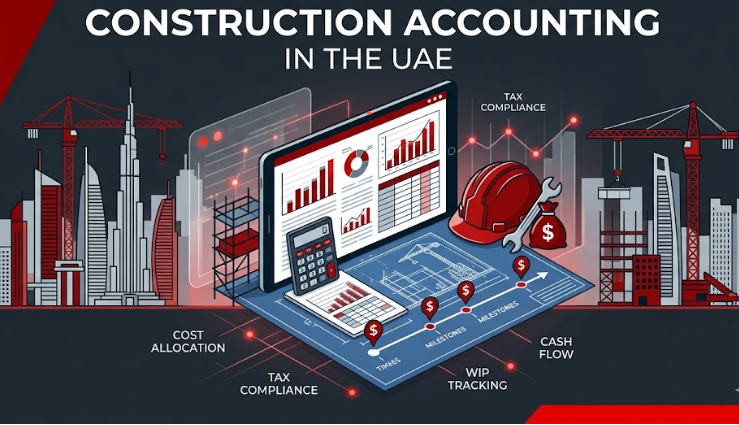
The UAE’s construction industry is expanding rapidly with large-scale real estate projects, government-backed infrastructure, and strong foreign investment. Reliable construction accounting in UAE has therefore become essential for ensuring business continuity and profitability.
Unlike traditional bookkeeping, accounting for construction companies in the UAE is project-based. Each project has unique expenses, schedules, and payment milestones, requiring accurate systems to track costs and comply with VAT and corporate tax.
This article outlines the main challenges, regulatory requirements, best practices, and accounting solutions for contractors and developers in the UAE.
Importance of Construction Accounting in UAE
Construction firms often manage multiple projects at once. Each project involves contracts, subcontractors, labour, and materials, all with different budgets and timelines. Without structured systems for construction accounting in Dubai and the wider UAE:
- Cash flow visibility declines.
- VAT and corporate tax compliance becomes more complex.
- Project costs are misallocated.
- Profit margins are underestimated.
Adopting project-based accounting allows firms to monitor costs in real time, allocate resources efficiently, and maintain compliance with UAE financial regulations.
Key Challenges in Construction Accounting
Revenue Recognition
Recognising revenue correctly is difficult for long-term projects with milestone-based payments, instalments, or advance billing.
Solution: Apply the percentage-of-completion method in line with IFRS 15 to match revenue with project progress.
Cost Allocation
Projects involve direct and indirect costs such as materials, labour, equipment, and subcontractors. Poor allocation can distort financial results.
Solution: Use job costing and project-specific records to assign expenses to the correct projects.
Labour and Subcontractor Management
Payroll and subcontractor agreements make up a significant share of costs. Manual handling of timesheets and invoices often leads to errors.
Solution: Integrate HR, payroll, and construction accounting software to track costs and payments accurately.
Cash Flow Fluctuations
Contractors often face delays in client payments while paying suppliers and labour upfront. This creates cash shortages that affect project delivery.
Solution: Develop project-specific budgets and implement regular cash flow forecasts to anticipate gaps.
Best Practices for UAE Construction Firms
To maintain financial stability, construction companies should adopt the following practices:
- Implement project-based accounting with separate cost centres.
- Reconcile work-in-progress (WIP) accounts monthly.
- Conduct regular project profitability reviews.
- Track income and expenses against budgets in real time.
- Invest in the best accounting software for real estate business and contractors that supports VAT and corporate tax reporting.
These practices help firms improve transparency, reduce disputes, and maintain compliance with UAE authorities.
Choosing the Right Construction Accounting Software
The right system simplifies compliance and improves efficiency. Popular options for construction accounting in UAE include:
- QuickBooks Projects: Strong in job costing and task tracking, suitable for small to medium contractors.
- Xero Projects: Offers mobile access and easy integration with third-party apps, ideal for firms needing flexibility.
- Zoho Books: Cloud-based, VAT-compliant, with features for invoicing and inventory management.
- Sage 300 Construction & Real Estate: A full ERP solution designed for large developers managing complex projects.
By choosing tailored systems, construction firms can monitor budgets, control supplier payments, and optimise VAT and corporate tax reporting.
Outsourcing Accounting Services in Dubai
Given the complexity of tax regulations, many firms prefer outsourcing accounting services in Dubai to professional providers. Outsourced specialists support contractors with:
- VAT and corporate tax compliance.
- Wage Protection System (WPS) payroll.
- Subcontractor payments and reporting.
- Project budgeting, financial planning, and audits.
- Supplier invoicing and cash flow monitoring.
Engaging external bookkeeping services in Dubai not only reduces compliance risks but also frees up internal teams to focus on project execution.
Conclusion
Accurate accounting systems, clear tax compliance, and reliable reporting are now critical for contractors and developers. Firms that adopt best practices, use robust software, or outsource to specialised service providers will be better positioned to manage costs, control risks, and achieve sustainable growth.
How We Supports Construction Companies
We provides personlised construction accounting services in Dubai and the UAE, designed specifically for contractors and project-based organisations. Its solutions include:
- Project cost monitoring and profitability analysis.
- Payroll management and subcontractor payments.
- VAT and corporate tax registration and reporting.
- Integration with leading construction accounting software.
- Ongoing financial reporting and advisory support.
As a trusted provider of accounting for construction companies in the UAE, We ensures compliance, strengthens financial clarity, and supports sustainable growth.