
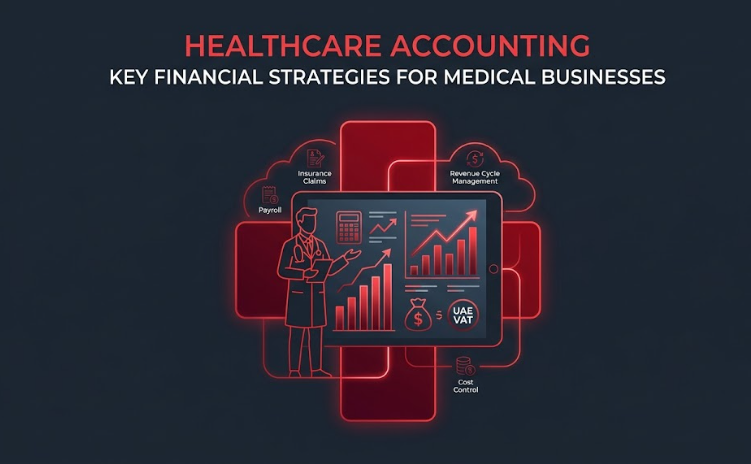
In today’s healthcare sector, sound financial management is as important as patient care. For hospitals, clinics, and private practices, healthcare accounting forms the foundation of stable operations. From payroll and insurance claims to VAT compliance and cost control, accurate accounting helps medical organizations reduce inefficiencies, improve cash flow, and remain compliant with UAE regulations.
This article outlines what healthcare accounting involves, why it matters, how technology is shaping the field, and the strategies medical providers can apply to strengthen financial performance.
What Is Healthcare Accounting?
Healthcare accounting is a specialized branch of accounting tailored to the needs of the medical industry. It covers:
- Tracking patient service revenue and reimbursements
- Managing payroll and operating costs
- Handling insurance claims
- Allocating budgets for staff and equipment
- Ensuring compliance with UAE VAT and corporate tax rules
Unlike traditional accounting, accounting for healthcare services must address diverse patient volumes, multiple payment systems, and strict reporting obligations from health authorities and regulators.
Why It Matters
Financial errors in healthcare can lead to delayed payments, penalties, or even license risks. A strong healthcare accounting system allows organizations to:
- Accurately monitor income from patients, insurers, and government programs
- Control costs while protecting care quality
- Produce timely and compliant financial statements
- Support informed investment and growth decisions
- Maintain transparency with regulators and stakeholders
Technology in Healthcare Accounting
Technology is transforming healthcare accounting services across the UAE. Cloud platforms and industry-specific software optimise routine tasks, including:
- Payroll and staff benefits administration
- Insurance claim filing
- Accounts receivable tracking
- VAT and corporate tax reporting
- Automated financial statement preparation
Integration with electronic medical records (EMRs) and AI-driven analytics provides insights that reduce costs, detect errors early, and improve efficiency. Automation also frees finance teams to focus on strategic planning rather than repetitive processes.
Essential Financial Techniques
1. Cost Management and Accounting
With rising operating expenses, cost control is critical. Healthcare providers must evaluate both fixed costs (rent, salaries) and variable costs (medical supplies, outsourced services). Real-time expense tracking, cost-per-patient analysis, and budgeting tools ensure resources are allocated effectively.
2. Compliance and Risk Management
Medical organizations in the UAE must meet tax regulations, Ministry of Health reporting standards, and labour law requirements. Structured accounting systems supported by routine audits reduce compliance risks and safeguard long-term stability.
3. Financial Reporting
Accurate financial statements such as income statements, balance sheets, and cash flow reports, reveal an organization’s financial health. They guide management decisions, support investor confidence, and meet government reporting obligations.
Revenue Cycle Management (RCM)
Revenue cycle management is a central part of accounting for healthcare providers. It covers the entire billing process, from patient registration and insurance verification to claims collection. Effective RCM helps organizations:
- Minimize denied claims
- Improve cash flow
- Speed up payment cycles
Automated tools, skilled billing teams, and regular audits strengthen revenue streams while reducing administrative delays.
Outsourcing Healthcare Accounting Services
Many medical organizations choose to outsource healthcare accounting services to professional firms. The benefits include:
- Access to industry-specific accounting software
- Fewer billing errors and faster reporting
- Expertise in UAE tax and healthcare regulations
- Lower overhead costs compared to in-house teams
Outsourcing allows doctors and administrators to concentrate on patient care while specialists handle complex accounting tasks with accuracy and efficiency.
Decision-Making Benefits
Healthcare accounting is not only about compliance but also about strategic growth. Reliable financial data enables executives to:
- Plan staffing levels based on demand forecasts
- Invest in new medical equipment with confidence
- Benchmark performance against industry standards
- Optimize service lines for profitability
In a competitive healthcare market, informed decision-making strengthens resilience and supports sustainable growth.
Conclusion:
Strong financial management is vital for healthcare organizations aiming to balance quality care with profitability. By adopting best practices in healthcare accounting, embracing technology, and seeking professional support, medical businesses can manage costs, ensure compliance, and expand with confidence.
How SimplySolved Can Help
We supports hospitals, clinics, and medical practices across the UAE with tailored healthcare accounting services. From VAT compliance and payroll processing to cloud-based financial reporting, our team delivers accurate and efficient solutions that meet industry demands.
Contact us today to optimise your healthcare accounting and strengthen your organization’s financial performance.