
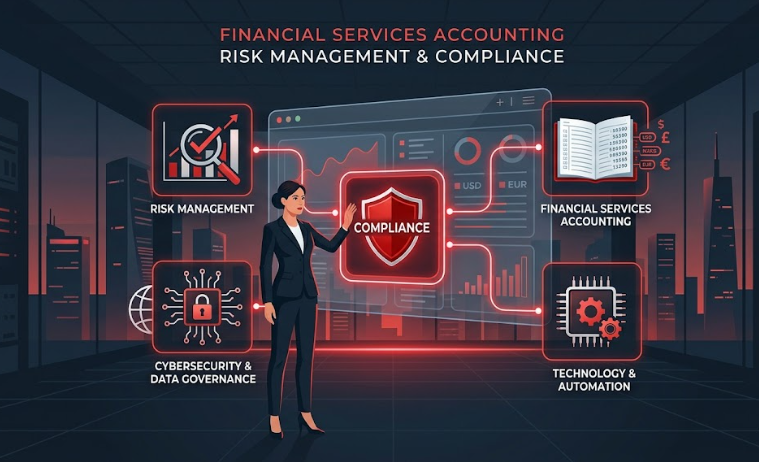
Financial services accounting is central to risk management, efficiency, and compliance in a highly regulated industry. Banks, insurers, asset managers, and fintech firms depend on accurate records to meet supervisory requirements and make informed decisions.
This article outlines best practices in financial services accounting, including internal controls, compliance, technology, and the use of financial accounting services. It also explains how disciplined processes support long-term stability and growth.
What Financial Services Accounting Includes
Financial services accounting extends beyond routine bookkeeping. It covers complex areas such as fair-value measurement, expected credit loss models, liquidity ratios, and capital adequacy. Institutions also prepare disclosures under IFRS and other international standards.
Coordination with risk and treasury functions is essential to ensure consistency and accuracy.
Why Accuracy and Compliance Matter
Incomplete or inaccurate records can lead to penalties, audit findings, reputational damage, and loss of investor confidence. Strong financial accounting and management practices improve transparency, support risk monitoring, and ensure compliance with evolving standards.
Effective financial services accounting enables institutions to:
- Comply with IFRS, Basel III, and central bank requirements.
- Track assets, liabilities, and off-balance-sheet exposures.
- Maintain internal controls and risk assessments.
- Deliver timely reports to regulators and stakeholders.
Role of Technology in Financial Services Accounting
Technology is reshaping financial services accounting and compliance. Modern platforms help institutions close faster, automate reporting, and detect anomalies in real time. Key benefits include:
- Shorter month-end and year-end close cycles.
- Continuous auditing and exception monitoring.
- Real-time dashboards for decision-making.
- Secure API integration with banking, trading, and payment systems.
- AI-driven anomaly detection and compliance alerts.
Selecting the right accounting software for financial services improves efficiency, strengthens reporting, and enhances compliance readiness.
Best Practices in Financial Services Accounting
1. Implement Strong Internal Controls
Internal controls reduce fraud, errors, and operational risks. Common measures include:
- Segregation of duties for approval, reconciliation, and recording.
- Access controls, audit trails, and change logs.
- Regular reconciliations of cash, custody, and trading accounts.
- Ongoing risk assessments and control testing.
2. Maintain Regulatory Compliance
Compliance is a constant priority. Standards and tax rules change frequently. Institutions should:
- Track updates to IFRS, Basel III/IV, and local regulations.
- Keep disclosures accurate and reports timely.
- Use compliance calendars, policies, and training programs.
Strategic use of external financial accounting services can support internal teams while management remains accountable.
3. Integrate Finance and Risk Functions
Finance and risk teams should work with shared data and consistent models. Practical steps include:
- Joint stress testing for market, credit, and operational risks.
- Alignment on liquidity ratios and capital adequacy.
- Shared ownership of models for ECL, fair value, and scenario analysis.
4. Strengthen Data Governance and Cybersecurity
High-quality accounting relies on secure data. Institutions benefit from:
- Standardized definitions and lineage mapping.
- Controlled data ingestion and transformation.
- Encryption, role-based access, and continuous monitoring.
5. Use Financial Accounting Services Strategically
Outsourcing or co-sourcing can increase efficiency and reduce costs. Areas that benefit include:
- IFRS consolidations and reporting.
- Internal audit preparation and audit readiness.
- Corporate tax and VAT compliance.
Specialist providers of financial accounting services apply international best practices while allowing internal teams to focus on operations.
Benefits of Strong Accounting Practices
Mature financial services accounting delivers clear advantages:
- Better risk management through early detection.
- Greater compliance confidence with regulators.
- Timely insights for boards and management.
- Cost efficiency through automation.
- Scalable processes that support expansion.
Common Challenges
Institutions face rapid regulatory change, increasing data volumes, cybersecurity risks, and a shortage of skilled professionals. A mix of strong internal controls, advanced technology, and external financial accounting services helps overcome these challenges.
Conclusion
In today’s regulated environment, financial services accounting is essential for risk management and compliance. Institutions that apply strong controls, adopt specialized technology, and use financial accounting services strategically are better positioned to meet obligations and achieve sustainable growth.
How We Can Help
We delivers financial services accounting that covers IFRS reporting, bookkeeping, VAT compliance, audit support, and managed finance operations. Using advanced accounting software for financial services, we automate reconciliations, streamline reporting, and enhance compliance. Get in touch with us today to simplify your accounting processes and strengthen financial management in the UAE.